A partnership between Buncombe County Schools and the Friends of the WNC Nature Center is expanding to bring immersive, place-based science education to every fourth-grade classroom in the district over the next two years.
In response to new Science Standards adopted by North Carolina in 2023, Kate Whittier, the K-12 Science Specialist for Buncombe County Schools, began the work of supporting teachers with a full curriculum for each grade level. Building on the success of a collaborative unit for third graders with the Asheville Museum of Science, she partnered with the Friends of the Nature Center to develop a two-week, fourth-grade science unit focused on native wildlife.
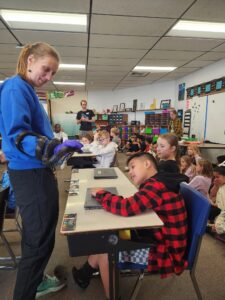
Bringing Science to Life
The co-designed curriculum, called Built to Thrive, combines teacher-led lessons, educational videos, and classroom visits featuring live animal ambassadors from the WNC Nature Center. Students also use investigation kits containing skulls and fur models to explore how animals’ physical and behavioral characteristics help them survive in the wild.
During the unit, educators from the Friends bring a live animal ambassador, such as a snake or turtle, directly to the classroom. Students are excited to learn about the animal when it arrives, building a strong memory and positive association with science learning. Those encounters are even more meaningful because students have already explored the concepts through their classroom lessons.
Outreach Education Program Manager Brian Wuertz has seen those connections firsthand: “I love hearing students refer to the video they’ve seen of Anakin, the Nature Center’s river otter, when we visit with an animal ambassador. They ask more complex questions and build a sense of pride in their learning by sharing what they already learned about our animals.”
Piloting the unit at seven elementary schools in 2025 showed promising results, Whittier says. “Teachers reported that the program strengthened their ability to provide experiential science learning while helping students connect standards to the wildlife and ecosystems of Western North Carolina.”
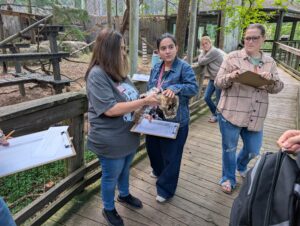
But meaningful educational experiences require more than great lesson plans. Teachers need the resources, preparation, and confidence to bring those lessons to life. In September 2026, a full-day workshop was held at the Nature Center for five Buncombe County fourth-grade science lead teachers. With support from the Community Foundation of WNC and the Institute of Museum and Library Services (IMLS), the Friends were able to fund the teachers’ participation, providing dedicated time to explore the curriculum and prepare to bring the lessons to their students.
Following the workshop, teachers shared how the experience prepared them to get students involved in hands-on science through the Built to Thrive unit. One said, “There are so many resources available that will make the concepts so much clearer for students.” Another reflected that the unit is “laid out in a way that allows student discovery to feel natural and self directed.”
The investment in teachers is part of a broader approach to expand access to nature-based education by helping educators bring local, applicable environmental science into their classrooms throughout the year.
Growing the Partnership and Expanding Access
This partnership reflects an evolution of the Friends’ Outreach Education work: moving beyond individual outreach visits to develop deeper relationships with school systems and create educational resources that can be used year after year. By working alongside educators to develop and refine curriculum, the Friends can extend the Nature Center’s educational reach beyond the number of programs its own staff can deliver in person.
Established in 2016, the Friends’ Outreach Education program brings affordable, accessible wildlife and environmental education beyond the Nature Center’s gates and into schools and communities across Western North Carolina. In 2025, the two-person team delivered nearly 400 programs across 14 counties, reaching almost 10,000 participants.
Built to Thrive is just the first chapter in an effort to connect local students with the plants and animals of the Southern Appalachians. The Friends are now planning a similar collaborative unit for eighth-grade students, focused on ecology. The unit is scheduled to be piloted in at least three Buncombe County middle schools during the 2027-2028 school year.
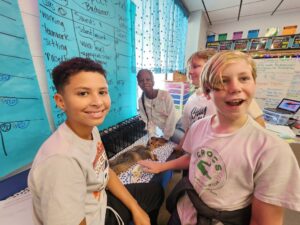
Early support from Duke Energy Foundation and the Community Foundation of WNC helped the Friends to pilot the original Built to Thrive curriculum and demonstrate its potential. These local investments positioned the Friends to secure a two-year award through the IMLS Inspire! Grants for Small Museums program, providing support to expand the fourth-grade curriculum across Buncombe County and develop the new eighth-grade unit.
“This work didn’t begin with a federal grant,” says Friends Executive Director Kate Frost. “It began with regional funders who believed in the potential of our Outreach Education program and invested in helping us test new ideas. Their early support made it possible to develop and pilot a curriculum, demonstrate its impact, and build the foundation for a much larger effort. The recent IMLS grant is an exciting next step, but it’s also a testament to how early investments from smaller funders can help turn promising ideas into programs with far-reaching impact.”
Together, the expanded fourth-grade programming and the new eighth-grade initiative are expected to directly reach approximately 2,200 students over two years, with additional students benefiting as teachers continue using the curriculum in future school years.
Where Science Meets Conservation
Since the 1970s, the WNC Nature Center has helped visitors connect with the animals and plants of the Southern Appalachians. But that connection doesn’t have to begin with a visit to the wildlife park. For many children, particularly those who may not have had the opportunity to visit the Nature Center before, their first meaningful encounter with native wildlife may happen in their own classroom.
Sometimes it begins with a student examining a skull and wondering why an animal’s teeth are shaped a certain way. Sometimes it starts with a student seeing firsthand that snakes have no ears and never blink. And sometimes, it grows when a teacher has the resources to make a science lesson memorable for an entire class.
These moments matter. Curiosity is often the first step toward understanding, appreciation, and a desire to protect the natural world. Through its partnership with Buncombe County Schools, the Friends of the WNC Nature Center is helping make those moments possible in more classrooms, for more students, and across more grade levels for years to come.
Learn more about the Friends’ Outreach Education Program here.